Replacing every bottle with a product labeled sustainable can leave you with more skincare, not less waste. You may buy a refill system before finishing the original container, or choose a large format that you will not use before it deteriorates. The packaging decision comes too late if the product itself had no clear role.
A lower-waste skincare routine starts with a simpler question: what do you actually use, tolerate and intend to replace? Answering that does not establish a product’s complete environmental footprint. It does help you avoid purchasing something that is likely to sit unfinished at the back of a shelf.
Give each purchase a job
Look at the functions you rely on rather than counting bottles. You might need cleansing, moisture, sun protection and a treatment directed by a clinician. Optional products can also have a place, but be clear whether you enjoy them or expect them to solve a particular cosmetic concern.
The aim is not to reach an arbitrary three-product limit. A routine with several useful, well-managed products can make more sense than buying a new all-in-one formula simply to appear minimalist. Keep the decision tied to your actual use, including whether a product works with the rest of your routine.
Before ordering a replacement, check whether another unopened product already performs the same job. Do not assume two differently named serums are different because their advertising highlights different benefits. Equally, do not assume that a repeated ingredient makes the combination unsafe. The label, formulation and directions still matter.
Separate overlap from a safety verdict
Write down product types and actives explicitly named on their labels. A short inventory lets you identify purchases that need a clearer purpose. It is not necessary to infer concentrations from an ingredient list or make a spreadsheet that pretends to predict every interaction.
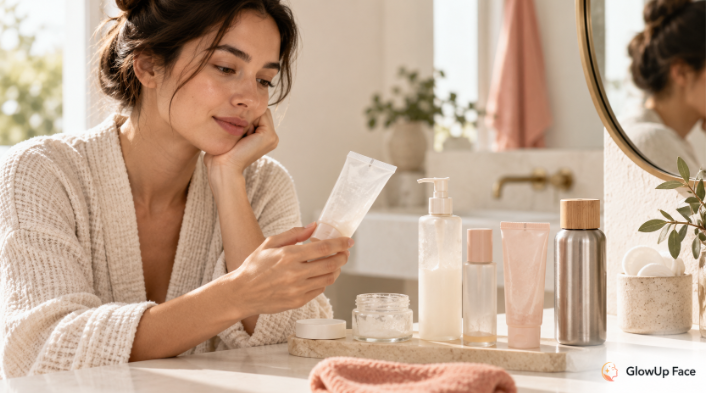
GlowUpFace’s skincare routine checker organizes the product types and recognized actives you enter, highlighting overlap and morning-versus-evening order. It is free, does not require signup, and keeps the entered routine text in the page. Its limited rules do not look up complete brand formulas or establish allergies, strength, pH or medical suitability.
Use the output to postpone an unclear purchase, not to override treatment or certify a routine as safe. “I already own two products serving this purpose” is enough to pause an order. You do not need a tool to prove that a third bottle is harmful before deciding it is unnecessary.
Do not turn finishing products into an obligation
Using what you own is not a reason to continue with something that irritates you or appears spoiled. The FDA’s explanation of cosmetic shelf life notes that storage, contamination and deterioration can affect products. Heat, moisture and repeated handling matter; the printed packaging is not the only variable.
Follow the manufacturer’s storage and disposal directions. Keep containers appropriately closed and avoid adding water or mixing leftovers to extend their use. Observe expiration dates on products such as sunscreen. A lack of visible change does not prove a product is still suitable, and a cosmetic organizer cannot test its preservation system.
Record an opening date when the label gives a period-after-opening instruction. That small piece of information is more useful than trying to remember whether a jar came from this year’s holiday or the last one. When you are uncertain, ask the manufacturer rather than guessing from a batch-code website.
Investigate what “refillable” means in practice
A refill system is useful only if you can obtain the correct refill, understand the instructions and continue using the original package. Check whether the refill is compatible with your exact product. Do not improvise a reusable system by pouring different formulas into a container that was not designed for that use.
The Federal Trade Commission’s Green Guides summary says unqualified refillable claims should be supported by a way to refill the package. It also explains that recycling claims depend on access to suitable facilities. These distinctions are useful questions for a consumer, not evidence that a particular skincare package has the lowest footprint.
Ask what the environmental statement actually covers: the bottle, the outer carton or the entire product. A claim about recycled packaging does not establish the impact of ingredients, transport or your pattern of use. Look for specific information rather than treating a leaf symbol or beige label as a complete assessment.
Buy the amount you will realistically use
A large bottle can have an attractive price per milliliter and still be poor value if you dislike the formula. Before buying a large format, consider how often you use the product, whether you already know it suits you and what its storage instructions require. Do not invent a fixed shelf-life rule that applies to all cosmetics.
For a new formula, follow the AAD’s guidance on testing skincare products and the product directions before making it part of your routine. A small-area trial can help identify a reaction, but it is not a guarantee against allergy or later irritation. Avoid bulk-buying simply because the first application felt pleasant.
Write a replacement rule you can keep
Try a rule such as: “I reorder this moisturizer when the current one is nearly finished and I still want the same formula.” Keep a separate note for a genuine gap rather than adding it straight to a cart. This creates a pause between discovering a product and deciding to own it.
The useful outcome is not a photogenic row of identical containers. It is fewer unexplained purchases, clearer product use and appropriate disposal when something should no longer be used. Packaging still matters, but it works best as the next question after deciding whether the purchase needs to happen at all.
 is a committed writer and environmental advocate at Eco Elegance Technique, specializing in sustainable practices, health, and wellness. With a background in environmental studies, Peter focuses on providing readers with practical advice on integrating eco-friendly habits into their daily routines. His work aims to inspire a deeper connection between personal well-being and environmental responsibility, making sustainability accessible and actionable for everyone.